

A Guide to Essential Metrics for Apps
Master the essential metrics for apps. This guide explains how to track, analyze, and optimize your app's performance for sustainable growth and success.
Think of your app's data as a language. If you learn to speak it, you can understand exactly what your app needs to thrive. The essential metrics for apps are all about translating that data into clear signals about user engagement, retention, and how well you're making money.
By keeping a close eye on these key performance indicators (KPIs), you get a real-time health check on your app, allowing you to make smart, data-driven decisions that actually lead to growth.
Listening to What Your App Is Telling You

Your app isn't just a piece of software; it's a living system constantly telling you how it's doing through the data it generates. In a market this crowded, knowing how to interpret that feedback is everything. The app world is booming, with total downloads expected to blow past 300 billion in 2025. You can dig deeper into these kinds of mobile app usage statistics on Vennapps.
With that kind of competition, just getting your app into the App Store is step one of a much longer journey. You need a solid plan to stand out. The secret is to ignore the vanity metrics and the firehose of data, and instead zero in on the vital signs that truly matter for a subscription-based iOS app.
Navigating with the Right Instruments
Imagine you're the captain of a ship. You wouldn't try to watch every single dial on the bridge at once. You'd focus on the critical instruments: the compass for direction, the speedometer for speed, and the radar for what's ahead. Trying to do more would just be overwhelming and, frankly, dangerous.
App analytics is exactly the same. Tracking dozens of different numbers at once is a classic recipe for analysis paralysis. A winning strategy means focusing on a handful of powerful metrics that answer the most fundamental questions about your business:
- Engagement: Are people actually using your app and its features?
- Retention: Do they like it enough to come back again and again?
- Monetization: Is the value you're providing compelling enough for them to pay for it?
By concentrating on these core areas, you turn confusing raw data into your most reliable guide. Suddenly, every decision—from what feature to build next to where to spend your marketing budget—becomes clearer and more effective because it's backed by real numbers.
This guide is designed to give you a strategic framework for picking the metrics that truly move the needle. We'll skip the textbook definitions and show you how to measure what counts, turning your data into a practical roadmap for sustainable growth.
The Three Pillars of Sustainable App Growth

You could easily drown in a sea of data points, but when you boil it all down, sustainable app growth really stands on three core pillars: Engagement, Retention, and Monetization. Getting a firm grip on these areas gives you a clear, actionable framework for diagnosing your app's health and making smarter decisions.
Think of them like a three-legged stool. If one leg is wobbly, the whole thing falls over. An app with amazing engagement but no real monetization strategy is just a fun hobby, not a business. And an app that's great at making money but can't keep users around is a leaky bucket—you'll constantly be scrambling to replace the customers you're losing.
Before we dive deep into the individual metrics, here’s a quick overview of how these three pillars work together to build a strong foundation for your subscription app.
The Three Pillars of App Metrics
| Pillar | Key Metric | What It Measures | Why It Matters for Subscription Apps |
|---|---|---|---|
| Engagement | DAU/MAU (Stickiness) | How often users interact with your app. | Proves your app is valuable and habit-forming, which is the first step toward earning a subscription. |
| Retention | Cohort Retention & Churn | How many users return over time. | High retention is the backbone of recurring revenue. You can't grow if you're constantly losing subscribers. |
| Monetization | LTV & MRR | How effectively you turn usage into revenue. | These metrics directly measure financial health and determine your budget for acquiring new customers. |
This table gives you the 30,000-foot view. Now, let's break down what each of these pillars actually looks like on the ground.
Engagement: The Heartbeat of Your App
Engagement metrics are your first signal that you've built something people actually want to use. They measure how actively and frequently users interact with your app. With an estimated 4.69 billion people owning a smartphone by 2025, the opportunity to build engaging experiences is massive. You can explore more data on the growth of mobile app usage on Brainvire.
The most common starting points are Daily Active Users (DAU) and Monthly Active Users (MAU). These simply count the number of unique users who open your app in a given day or month.
But the real magic happens when you look at the DAU/MAU ratio, often called the "stickiness" ratio. If you have 1,000 DAU and 10,000 MAU, your ratio is 10%. This tells you that the average user comes back on 3 out of 30 days. Is that good? It depends. That might be low for a daily meditation app but perfectly fine for an app that helps you book flights once a quarter.
Retention: Keeping Users Loyal
Retention is all about how many users come back to your app over time. For a subscription business, this isn't just important—it's everything. Your entire business model is built on long-term loyalty, so a high retention rate is one of the strongest signs you have a solid product-market fit.
The two metrics that tell this story are Retention Rate and Churn Rate.
- Retention Rate: This is the percentage of users who return after a certain period. It's best measured using cohorts (groups of users who signed up around the same time). For instance, you’d ask, "What percentage of the users who signed up in January were still active in February?"
- Churn Rate: This is the flip side of retention. It’s the percentage of subscribers who cancel in a given period. If you start a month with 1,000 subscribers and 50 of them cancel, your monthly churn rate is 5%.
By analyzing retention by cohort, you can start to see if your product updates are actually moving the needle. If your April cohort sticks around longer than your March cohort, you know you're doing something right.
Monetization: Turning Value Into Revenue
Finally, monetization metrics show how well you're converting all that engagement and loyalty into actual revenue. For subscription apps, this is about building predictable, recurring income streams, not just chasing one-off sales.
Here are the heavy hitters:
- Monthly Recurring Revenue (MRR): This is the predictable revenue your app brings in every month from all active subscriptions. It's the lifeblood of any subscription-based business.
- Average Revenue Per User (ARPU): Simply your total revenue divided by your total number of users. It gives you a bird's-eye view of what each user is worth on average.
- Lifetime Value (LTV): This is a forecast of the total revenue you can realistically expect from a single customer over their entire time with your app. A healthy LTV is critical because it tells you exactly how much you can afford to spend to acquire a new customer and still be profitable.
Getting comfortable with these interconnected financial numbers is fundamental to building a profitable app. To go even deeper, check out our guide on essential subscription business metrics.
Together, these three pillars give you a complete, honest picture of your app's performance, helping you focus on the metrics that truly drive growth.
Setting Up Your App for Accurate Measurement
Knowing which metrics to track is half the battle. The other half—the part where the real work begins—is actually capturing that data accurately. If you want clean, reliable insights, you have to instrument your app correctly right from the start.
This all starts with event tracking. Think of events as digital breadcrumbs your users drop as they navigate your app. Every important action, from TrialStarted to OnboardingCompleted or SubscriptionPurchased, gets tagged as a unique event. This stream of user actions becomes the foundation for all your analytics.
The Role of SDKs and Event Tracking
Now, you could try to build a complex data collection system from the ground up, but why reinvent the wheel? Most developers lean on a Software Development Kit (SDK) from platforms like Mixpanel, Amplitude, or RevenueCat to handle the heavy lifting.
Integrating an SDK is like hiring a specialized crew to install a sophisticated sensor network in your app. These tools are built to capture, organize, and send your event data to an analytics dashboard, saving you a ton of time and engineering headaches. For example, getting started is often a quick process; you can see how to integrate the Nuxie iOS SDK in just a few minutes.
Setting this up properly ensures your data isn't just collected—it's structured in a way that makes it far easier to analyze down the road.
A well-instrumented app doesn't just collect data; it tells a story. Each event is a word, and together, they form a narrative about the user journey, revealing where users find value and where they get stuck.
Essential Events for Subscription Apps
You could track hundreds of different actions, but you'll get the most clarity by focusing on a core set of foundational events first. For any subscription-based iOS app, these are the non-negotiables:
- App Install: The very first touchpoint a user has with your app.
- Onboarding Completion: This tells you the user made it through your initial setup and (hopefully) understands what your app does.
- Trial Started: A massive signal of user intent and a critical conversion point.
- Subscription Purchased: The ultimate goal. This is when a user becomes a paying customer.
- Subscription Canceled: Essential for understanding churn and spotting patterns among users who decide to leave.
Understanding Where Users Come From
Finally, no measurement setup is complete without mobile attribution. This is all about connecting a user's in-app behavior back to the specific ad campaign or marketing channel that brought them there.
Attribution tools help you answer the most important marketing questions. "Did that Instagram campaign actually bring in users who start trials, or did it just drive a bunch of low-quality downloads?" Without this piece of the puzzle, you're just throwing money at the wall and hoping something sticks.
By linking your acquisition channels to monetization metrics like LTV, you can see exactly which campaigns are delivering valuable, long-term customers. That's how you make sure every dollar you spend on growth is working as hard as it possibly can.
Analyzing Funnels to Pinpoint Growth Opportunities
Users don't just appear out of thin air as paying subscribers. They take a journey, and mapping that journey is one of the most powerful things you can do. This map is called a conversion funnel, and it shows you exactly where people are dropping off on their way to becoming a customer.
Think of it like a multi-stage race. Your job is to get as many runners as possible across the finish line.
For most subscription apps, the race has a few key checkpoints:
- App Install: The starting gun. They've downloaded the app.
- Onboarding Completion: They’ve made it through the setup and understand the basics.
- Free Trial Start: They’re interested enough to try out the premium experience.
- Paid Conversion: The finish line. They’ve become a paying subscriber.
By tracking the percentage of people who make it from one stage to the next, you can see exactly where your growth engine is sputtering.
Finding the Leaks in Your Funnel
Let’s imagine you dig into your numbers. You see that 90% of users who install the app also complete your onboarding flow. Fantastic! But then, the next number is a shocker: only 10% of those people go on to start a free trial.
You just found a massive leak.
This tells a very specific story. Your onboarding is doing a decent job of showing people around, but your paywall is failing to convince them that the premium features are worth trying. You've gone from guessing what's wrong to having a clear, data-backed problem to solve.
Of course, getting this data requires setting up the right measurement system in your app.
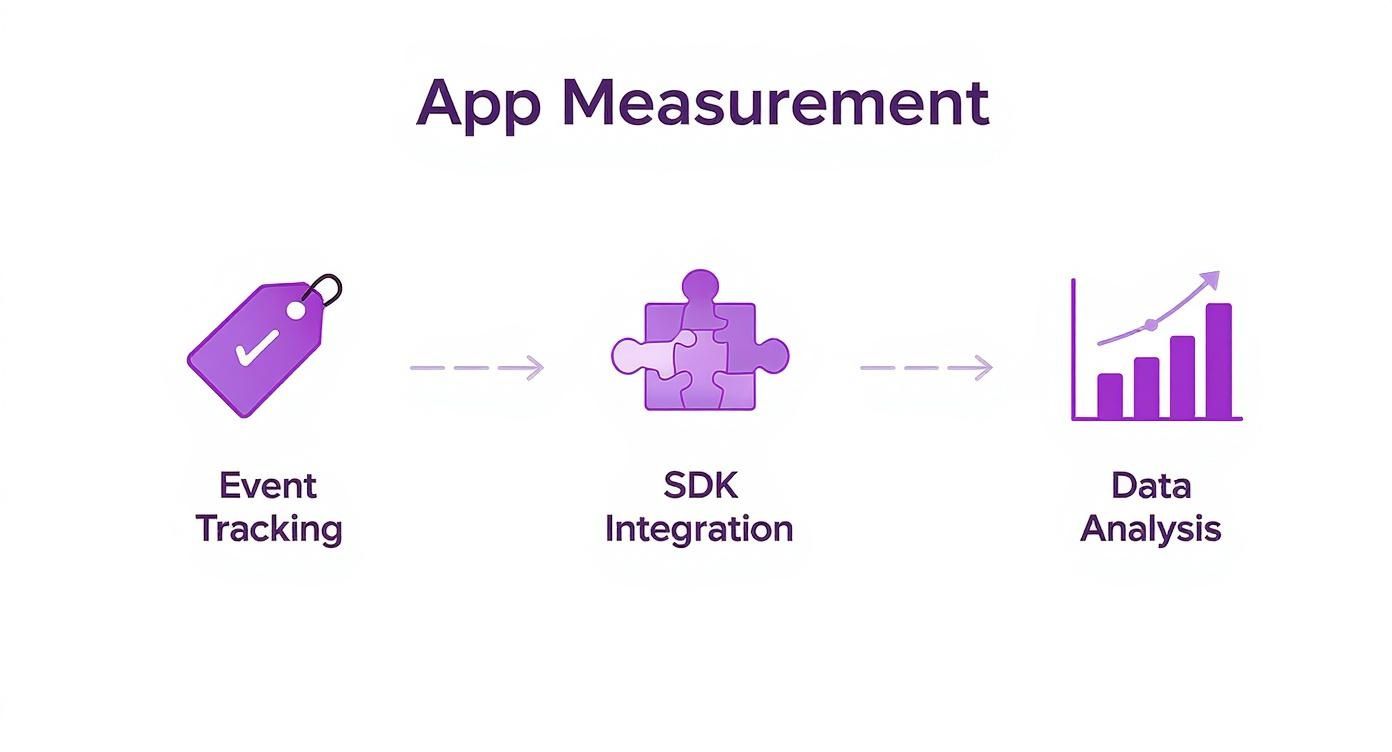
It all starts with tagging specific user actions (Event Tracking), which then get sent to your analytics tools through an SDK. That collected data is what ultimately populates your funnel reports (Data Analysis), giving you the insights you need.
Diagnosing and Fixing Funnel Drop-Offs
Once you’ve spotted a drop-off point, it’s time to play detective. Why are people leaving at this exact moment?
The usual suspects often include:
- A confusing UI: Maybe the button to start the trial is buried, or the benefits aren’t clearly listed.
- A weak value proposition: The user simply doesn't understand why they should bother upgrading.
- Too much friction: Asking for a credit card upfront can feel like too big of a commitment.
- A poorly designed paywall: The layout is clunky, or the messaging just doesn't land.
Funnel analysis is the difference between guessing and knowing. It’s like a doctor using an X-ray to pinpoint the exact source of the pain instead of just treating the symptoms.
With a solid hypothesis in hand, you can start running targeted experiments. A/B test a new paywall design, rewrite your call-to-action, or simplify the sign-up process. Systematically finding and plugging these leaks is how you build a truly high-growth app. For more tactical ideas, check out these conversion rate optimization best practices. This methodical work ensures you're spending your time on changes that actually move the needle.
8. Putting Your Metrics into Action to Drive Results
So, you've got all this data. What now? Gathering numbers is just the starting line. The real magic happens when you use those insights to make smarter decisions that actually move the needle on growth. Your analytics dashboard shouldn't be a passive report you glance at once a week; it needs to be an active engine for improvement.
This is all about building a continuous feedback loop. It's a simple but incredibly powerful cycle: measure a key metric, come up with a hypothesis on how to improve it, run a focused experiment, and then analyze the results to figure out your next move. This is how you turn raw numbers into a genuine playbook for growth.
https://www.youtube.com/embed/eiIhTbFP0ls
Driving Conversions with A/B Testing
One of the best ways to put your metrics to work is through A/B testing. At its core, this is just a disciplined way of comparing two versions of something—a screen, a button, a piece of copy—to see which one gets you closer to your goal.
Let's take a classic example for a subscription app: improving your trial-to-paid conversion rate. Say your funnel analysis shows a massive drop-off right at the paywall. You have a hunch that your current messaging is too focused on a dry list of features and not the actual benefits users will feel.
Time to test that theory. You can set up a simple A/B test:
- Version A (Control): Your current paywall that says, “Unlock All Features.”
- Version B (Variant): A new version that frames the value differently, like “Start Your Transformation Today.”
You'd then show each version to 50% of your new trial users and see which one convinces more people to pull out their credit cards. This single experiment cuts through the guesswork and gives you hard data on what truly resonates with your audience.
Using Churn Data to Save Subscribers
Your metrics can also be a powerful tool for proactive retention. Let's say you dig into your churn data and discover that a specific group of users almost always cancels around the three-month mark. That’s not just a statistic; it’s a goldmine of an insight.
Instead of just accepting that churn, you can build a targeted "churn-busting" campaign. This starts with identifying users who are showing early signs of disengagement or those who actively try to cancel. When a user in this high-risk group taps the "cancel subscription" button, you don't just wave goodbye.
Instead, you can trigger a perfectly timed offer based on their action. A simple pop-up offering a 30% discount for the next three months can be shockingly effective at saving a subscriber who might just be feeling a temporary financial pinch but still loves your app.
This tactic directly turns a negative signal (a cancellation attempt) into a positive outcome (a saved subscriber). By connecting your churn metrics to a specific, automated action, you create a system that actively fights to keep your hard-won customers. Suddenly, every decision becomes a new opportunity to test, learn, and improve.
Sample A/B Test Ideas for Key App Metrics
To get your creative juices flowing, here are a few practical A/B test ideas you can run to improve some of the core metrics we've discussed. Think of this table as a starting point for building your own experimentation roadmap.
| Metric to Improve | A/B Test Idea A (Control) | A/B Test Idea B (Variant) | Hypothesis |
|---|---|---|---|
| Trial-to-Paid Rate | A paywall with a single "Annual Plan" highlighted. | A paywall offering a "Monthly Plan" and "Annual Plan" with the annual option showing "Most Popular" and a discount. | Adding a monthly option will reduce initial friction, while highlighting the annual plan's value will still drive higher LTV conversions. |
| User Retention | Standard push notification: "Don't forget to complete your daily session!" | Personalized push notification: "Hey [User Name], you're only 2 steps away from your weekly goal!" | A more personal and goal-oriented notification will feel more motivating and increase daily engagement, leading to better long-term retention. |
| ARPPU | A single upsell offer for a "Pro" plan after 1 month of use. | A tiered upsell strategy: offer a "Pro" plan at 1 month, and a "Pro Plus" plan with exclusive features at 6 months. | Introducing a higher-tier plan to loyal, long-term users will increase the average revenue from our most engaged paid subscribers. |
| Churn Rate | A standard cancellation flow with a single "Confirm Cancellation" button. | A cancellation flow that asks for a reason, then offers a targeted solution (e.g., a 1-month pause or a 25% discount). | Proactively addressing the user's reason for leaving with a relevant offer will save a significant percentage of potential churners. |
Remember, the goal of each test is not just to find a "winner" but to learn something valuable about your users. Every result, whether it proves or disproves your hypothesis, gives you a clearer picture of what your audience wants and how you can deliver it.
Frequently Asked Questions About App Metrics
Diving into app analytics can feel a bit like learning a new language. As you start tracking the metrics that matter, a lot of questions pop up. It's totally normal to wonder if you're looking at the right numbers or what they really mean for your app. Let's tackle some of the most common questions developers ask.
What Are Vanity Metrics and Why Should I Avoid Them?
Vanity metrics are the numbers that feel great to share but don't tell you much about the actual health of your business. The classic example? Total app downloads.
Hitting a million downloads sounds amazing, but what does it really tell you? If 99% of those people opened your app once and then disappeared forever, that big number is just an illusion of success. It's all sizzle and no steak.
Chasing these kinds of metrics can lead you down the wrong path, like blowing your marketing budget to get a flood of low-quality users who churn out almost immediately.
Focus on actionable metrics instead. Things like your DAU/MAU ratio, cohort retention, and Lifetime Value (LTV) give you the real story. They show you whether you’re building something people genuinely value and a business that can last.
How Often Should I Check My App Metrics?
The honest answer? It depends on what you're looking at. There’s no one-size-fits-all schedule. I find it helpful to think about metrics in two buckets: tactical and strategic.
- Tactical Metrics: Think of these as your app's daily heartbeat. Metrics like Daily Active Users (DAU), new trial starts, or session length are worth checking daily or every few days. They help you spot immediate issues or see the impact of a small change right away.
- Strategic Metrics: These metrics paint the bigger picture over time. LTV, churn rate, and Monthly Recurring Revenue (MRR) need a longer runway to reveal meaningful trends. Looking at these weekly or, more commonly, monthly is the way to go. Checking them daily is a recipe for anxiety, as you’ll just be reacting to normal, everyday wobbles.
A solid routine is to have a dashboard for the daily tactical stuff and a dedicated monthly meeting to review your strategic goals. This keeps you on top of things without getting bogged down in the noise.
What Is a Good Churn Rate for a Subscription App?
This is the million-dollar question, and the answer isn't a single number. A "good" churn rate can vary wildly based on your app's price, industry, and audience.
That said, for most consumer subscription apps, a monthly churn rate between 5% and 10% is generally considered a healthy baseline.
If you can get your churn below 5%, you're in fantastic shape. It's a strong sign that you've found a solid product-market fit and your users are happy. On the flip side, if your churn is consistently creeping above 10%, it’s time to dig in and figure out what’s going on with your onboarding, value proposition, or user experience.
The most critical thing is the trend. Is your churn rate going down over time as you make improvements? Even better, look at churn by cohort. If your newer users are sticking around longer than your early adopters, that’s a clear signal you’re moving in the right direction.
Ready to stop guessing and start knowing what drives your app's revenue? Nuxie provides an AI-powered paywall studio and campaign platform to help you design, target, and launch high-converting offers in minutes—no app updates required. Learn how Nuxie can help you optimize your monetization strategy.