
Mobile Application Optimization: Increase Downloads and Retention
Discover mobile application optimization tactics to boost downloads, retention, and revenue with practical tips on performance, ASO, UX, and monetization.
Mobile application optimization isn't just a technical task; it's the ongoing commitment to making your app faster, smoother, and more discoverable. Think of it as the lifeblood of any successful app—the crucial difference between an app that flourishes and one that fades into the background of a jam-packed market. It's a strategic blend of performance tuning, thoughtful user experience, and savvy marketing.
Why Your App's Success Hinges on Optimization

Just building and launching an app is no longer enough. The digital arena is incredibly competitive, and users now expect perfection. A clunky, slow, or confusing app doesn't just fail to win over new people; it can genuinely hurt your brand's reputation.
Optimization isn't a one-and-done fix. It's a continuous business discipline that fuels sustainable growth, directly influencing every metric that matters, from acquisition costs and conversion rates to long-term user loyalty.
Navigating a Fiercely Competitive Market
The sheer size of the app economy makes optimization a must-have, not a nice-to-have. Global app downloads are on track to reach a staggering 299 billion by 2025, climbing from 257 billion in 2023. This explosion is fueled by new smartphone users in emerging markets, with countries like India, Brazil, and Indonesia adding over 28 billion new installs in 2024 alone. In a sea this vast, only a flawless user experience will keep you afloat. You can explore more mobile app download statistics at Tekrevol.
What does this mean for you? It means your app is up against millions of others, all fighting for the same limited user attention. A single crash, a slow-loading screen, or a confusing button is all it takes for someone to hit "uninstall" and find a better alternative.
Meeting Sky-High User Expectations
Modern app users have absolutely no patience for friction. Their standards are set by the best-in-class apps they use every day—the ones that are lightning-fast, intuitive, and always reliable. A delay of just a few hundred milliseconds or one confusing step during sign-up can send them running.
This is where mobile application optimization comes in. It's all about directly addressing what users want most:
- Speed and Performance: The app must load in a snap, respond instantly to every tap, and never crash or freeze.
- Intuitive UX: The user journey should feel effortless and logical, from the first time they open the app to completing a core action like making a purchase.
- Discoverability: Your app needs to be easy to find in the app stores through smart App Store Optimization (ASO).
Optimization is the art and science of removing every possible barrier between a user and the value your app provides. The fewer obstacles they encounter, the more likely they are to stay, engage, and convert.
To put it bluntly, ignoring optimization is like pouring water into a leaky bucket. You can spend a fortune on marketing to get new users, but they’ll disappear just as quickly if the in-app experience is poor. A real commitment to continuous improvement is the only path to building a loyal user base and a profitable mobile business.
Here's a high-level overview of the optimization pillars this guide will cover, giving you a clear roadmap of the strategies we'll explore.
The Core Areas of Mobile App Optimization
| Optimization Pillar | Primary Goal | Key Metrics to Track |
|---|---|---|
| Performance Tuning | Enhance speed, responsiveness, and stability. | App Load Time, Crash Rate, ANR Rate, CPU/Memory Usage |
| UX & Conversion | Create a frictionless user journey to boost engagement. | Onboarding Completion, Feature Adoption, Conversion Rate |
| App Store Optimization (ASO) | Increase visibility and downloads in app stores. | Keyword Rankings, Impressions, Store Page Conversion Rate |
| Instrumentation & Analytics | Gather data to understand user behavior and identify issues. | Daily Active Users (DAU), Session Length, Retention Rate |
| Experimentation (A/B Testing) | Validate hypotheses and make data-driven decisions. | Uplift in Conversion, Statistical Significance, User-Level Funnels |
Each of these pillars is a critical piece of the puzzle. By focusing on them together, you create a powerful flywheel effect that drives sustainable growth for your app.
Building a Fast and Stable App Foundation

Before you can even dream about perfecting user flows or clever monetization strategies, your app has to be rock-solid. A fast, stable, and responsive experience is the absolute bedrock of mobile optimization. Without it, everything else you build is on shaky ground.
Users today have zero patience for sluggish apps or unexpected crashes. That first impression is often their last. In fact, research shows that 53% of users will abandon an app if it takes more than three seconds to load. That initial lag isn't just a minor annoyance—it's a massive red flag that screams "unreliable," sending users running before they've even started.
Slashing App Launch Times
Your app's launch is a race against a user’s dwindling patience. The goal is simple: get them from tapping the icon to interacting with the UI as fast as humanly possible. This is what we call "time to interactive" (TTI), and it's one of the most critical performance metrics you can track.
To win this race, you have to be ruthless. Audit every single process that fires during startup. Defer anything that isn't absolutely essential for that first screen. Think about third-party SDKs that don’t need to be initialized immediately or complex UI elements that aren't even visible yet.
Let's take a retail app as an example. Does it really need to load the entire product catalog, high-res images for every single category, and the user's complete order history just to display the home screen? Of course not. Focus on loading only what's necessary for that initial view and use techniques like lazy loading to fetch the rest in the background once the user is already engaged.
Optimizing Network Calls for an Instant Feel
Most apps are constantly talking to servers—fetching data, sending updates, and keeping things in sync. How you manage these network requests has a huge impact on how fast your app feels. A slow API response can make even the most beautiful UI feel clunky and broken.
A few practical strategies here can make a world of difference:
- Batch Your Requests: Instead of making five different API calls to populate one screen, see if you can consolidate them into a single, efficient call. This dramatically reduces the connection overhead.
- Use Efficient Data Formats: If you're still using bulky formats like XML, it's time to move on. More compact options like JSON or Protocol Buffers can shrink your data payloads significantly.
- Implement Smart Caching: This one is huge. Don't re-fetch data that hasn't changed. A solid caching strategy, where data is stored locally on the device, can make subsequent loads feel instantaneous because you’re not even hitting the network.
Imagine a social media app. When a user opens their feed, you can show them cached content from their last visit immediately while you fetch new posts in the background. This creates the illusion of instant loading and a much smoother experience.
Key Takeaway: Performance isn't just about making the app technically fast; it's about making it feel fast. User perception is the reality that dictates satisfaction and retention.
Preventing Crashes and Memory Issues
Nothing kills user trust faster than an app that crashes. While you'll never eliminate every single bug, proactive memory management and stability monitoring are completely non-negotiable.
So many crashes come down to memory issues, especially on older devices with limited RAM. Memory leaks, where your app hangs onto memory it no longer needs, are silent killers. They build up over time until—BAM—the app crashes. You have to get into the habit of using profiling tools like Xcode's Instruments to hunt down and plug these leaks.
Beyond that, you need to obsess over your crash-free user rate. You should be aiming for 99.9% or higher as a core team KPI. Tools like Firebase Crashlytics or Sentry are essential, giving you real-time reports with the detailed stack traces needed to find and fix issues before they blow up. A stable foundation isn't just about speed; it's about building a reliable product that users can depend on.
Designing a User Experience That Converts
A fast, stable app is just the starting line. What really turns an app from a one-time download into a daily go-to is an exceptional user experience (UX). This is where we stop thinking just about code and start focusing on bridging the gap between clean, intuitive design and real business results—like better engagement, retention, and, of course, revenue.
Great UX isn't about flashy animations or trendy color palettes. It's about empathy. It's about getting into the user's head, anticipating their needs, and carving out an effortless path for them to get what they came for. Every interaction should feel natural, logical, and satisfying.
Mapping and Simplifying Critical User Journeys
Every app has its own set of "critical user journeys"—the essential steps a user takes to get value. This could be anything from signing up, to making that first purchase, or completing a core feature's main task. The first thing you need to do is map these flows out, screen by screen, and hunt for any friction points.
Let's take a food delivery app as an example. The core journey is obvious: open the app, find a restaurant, pick a dish, and check out. Where could it all go wrong?
- Is the search bar buried, or is it front and center?
- Are the menu items clear, with good photos and visible prices?
- Does adding an item to the cart take one tap or three?
- Is the checkout process a maze of unnecessary fields and confusing steps?
By obsessively simplifying each step, you're making it easier for users to succeed. Fewer taps, clearer labels, and a logical flow are the secret ingredients to a journey that converts. This is the heart of mobile application optimization.
The best user experiences are the ones you don't even notice. When a journey is truly seamless, the user isn't thinking about your interface at all—they're just effortlessly getting things done. That's the kind of frictionless experience that builds loyalty.
Driving Action with Intuitive Navigation and CTAs
Once you've smoothed out the journey, you have to be the user's guide. This all comes down to two things: intuitive navigation and compelling calls-to-action (CTAs). If people can't find what they're looking for or don't know what to do next, they’ll get frustrated and bounce.
Your navigation needs to be predictable. Stick to patterns users have learned from other popular apps. Hiding key features behind a cryptic icon or deep inside a hamburger menu is a classic way to kill engagement before it even starts.
Likewise, every screen should have a clear purpose and a primary action. Your CTAs—the buttons that tell users what to do—need to be impossible to miss. Use strong, action-oriented words, high-contrast colors, and smart placement to guide the user's eye and make the next step a no-brainer. A button that says "Start Your Free Trial" is always going to beat a vague "Submit."
Boosting In-App Conversions and Revenue
At the end of the day, optimizing the user experience is about driving measurable business outcomes. The stakes have never been higher. Mobile devices now account for over 60% of global internet traffic and a staggering 70% of all e-commerce traffic. With mobile purchases expected to hit $678 billion in 2024 and projected to skyrocket to $2.4 trillion by 2030, a clunky experience is like leaving a pile of cash on the table.
Think about this: if your page takes more than five seconds to load, bounce rates can leap by 90%. That's a direct hit to your bottom line.
This is where Conversion Rate Optimization (CRO) becomes your best friend. CRO is the science of systematically testing and refining different parts of your app to get more users to take a desired action—whether that's signing up, upgrading, or making a purchase. For a deeper dive, check out our guide on https://nuxie.io/blog/conversion-rate-optimization-best-practices for mobile apps.
By applying solid CRO principles to your onboarding flows, checkout funnels, and paywalls, you can unlock major gains in user activation and revenue without spending a single extra dollar on acquiring new users.
Mastering App Store Optimization to Get Discovered
Building a brilliant app is a massive accomplishment, but it's only half the job. What good is a powerful, seamless app if no one can find it? This is where App Store Optimization (ASO) comes in, acting as the engine for your organic growth and a non-negotiable part of any serious mobile application optimization plan.
Think of ASO as SEO for the app world. It’s the continuous process of making your app more visible in the Apple App Store and Google Play Store to drive more organic downloads. Get it right, and when someone searches for a solution you offer, your app is the one they see first.
Decoding App Store Ranking Factors
While the exact algorithms are kept under lock and key, we have a very clear picture of what matters. Both Apple and Google prioritize two main things: relevance (how well you match a search query) and quality (how users are actually engaging with your app).
Your app's metadata—the text, keywords, and descriptions you provide—is how you signal relevance. User engagement signals like download velocity, ratings, and reviews are the proof of quality. To climb the charts, you absolutely have to nail both.
Crafting Your ASO Metadata
Your product page is your digital storefront. Every single element needs to work together to grab attention and convince people to download.
Here's what you can directly control:
- App Title and Subtitle: This is prime real estate. We've seen apps jump in rankings just by adding a primary keyword to their title. Use the subtitle (iOS) or short description (Google Play) to add more context and another high-value keyword.
- Keyword Field (iOS) vs. Full Description (Google Play): Apple gives you a tight 100-character field, so every character counts. Google, on the other hand, indexes your entire description. This gives you more room to weave in your primary and secondary keywords naturally.
- Promotional Text: This is a handy little field at the top of your iOS description that you can change anytime. It’s perfect for shouting out new features, running a sale, or highlighting a recent award without needing to submit a new app build.
The goal is to find that perfect balance between feeding the algorithms with keywords and writing compelling copy that speaks to a real person. Don't just stuff keywords—tell a story about the value you deliver.
Designing Visuals That Stop the Scroll
People scroll through the app stores at lightning speed. Your creative assets are what will make them slam on the brakes. A generic icon or boring screenshots can sink a potential download before they even read a word of your description.
Your visuals need to scream value in a matter of seconds.
- The App Icon: This is the face of your brand. It must be simple, memorable, and stand out on any phone background. Steer clear of tiny text and focus on a clean, bold design that’s instantly recognizable.
- Screenshots & App Preview Videos: Don't just throw up random screens of your UI. Curate your screenshots to tell a visual story. Highlight your best features and use short, punchy captions to explain the benefit. A slick preview video is even better, as it shows your app in action and can forge an instant connection.
Finally, you have to actively manage your reputation. Those stars and reviews are incredibly persuasive social proof. Proactively encouraging your happiest users to leave feedback creates a virtuous cycle of growth. This organic discovery is a critical pillar that works hand-in-hand with paid efforts. You can learn more about blending these two in our guide to app user acquisition strategies. By building a strong ASO foundation, you create a much more resilient and sustainable path to growth.
Creating a Cycle of Data-Driven Improvement
Real mobile optimization isn't about guesswork or following your gut. The most successful apps build a sustainable process for continuous improvement, turning raw user data into their most powerful asset. It’s all about making smart, data-backed decisions that build on each other over time.
This means you have to shift your focus away from vanity stats like total downloads. Instead, zero in on the metrics that actually reflect the health of your app—things like feature adoption, user churn, and lifetime value. That's how you get a clear, honest picture of what’s working and what isn’t.
The financial stakes here are massive. Global in-app purchase revenue hit $150 billion in 2024, a 13% year-over-year jump and the highest growth rate since 2021. With mobile ad revenues expected to blow past $400 billion by 2025, you simply can't afford to leave monetization to chance. You can dig into more mobile optimization revenue trends from Adnimation to see just how big the opportunity is.
Building Your Analytics Foundation
Before you can improve anything, you have to measure it accurately. Setting up solid instrumentation is the non-negotiable first step. It’s how you understand what people actually do in your app, not just what you assume they do.
This goes way beyond basic session counts. You need to track the key events in your user journey to map out funnels and spot exactly where users are dropping off. For an e-commerce app, for example, you'd want to trace the entire path from someone viewing a product to adding it to their cart and finally checking out.
Here are a few core metrics to build your foundation on:
- Feature Adoption Rate: What percentage of your active users actually engage with your key features? This tells you if your core value proposition is connecting with people.
- Retention Rate: How many users are still coming back a day, a week, or a month after their first visit? This is the ultimate signal of a sticky, valuable product.
- Customer Lifetime Value (LTV): On average, how much revenue does a user bring in over their entire relationship with your app? When your LTV is higher than your customer acquisition cost (CAC), you’ve got a healthy business.
Designing and Running Effective Experiments
Once you have reliable data flowing in, you can start forming hypotheses. A good hypothesis isn't just a random idea; it’s an educated guess about a change that will cause a specific, measurable improvement. For instance: "Changing our checkout button from blue to green will boost tap-through rates by 10% because green creates a stronger sense of 'go'."
This is where A/B testing becomes your best friend. It’s essentially the scientific method applied to product development, letting you validate ideas with real user behavior instead of just opinions. You show one version of your app (the control) to one group and a second version with your change (the variant) to another, then see which one performs better.
Effective experimentation is the engine of optimization. It systematically eliminates uncertainty and replaces assumptions with hard data, ensuring that every change you make is a step in the right direction.
By running these tests, you can make informed calls on everything from tiny button text to complex user flows. For a complete walkthrough on how to get started, check out our in-depth guide on A/B testing for mobile apps. This process takes the risk out of product development and makes sure your engineering team is spending time on changes that truly move the needle.
The process for App Store Optimization is built on a very similar iterative cycle of research, creation, and performance tracking.
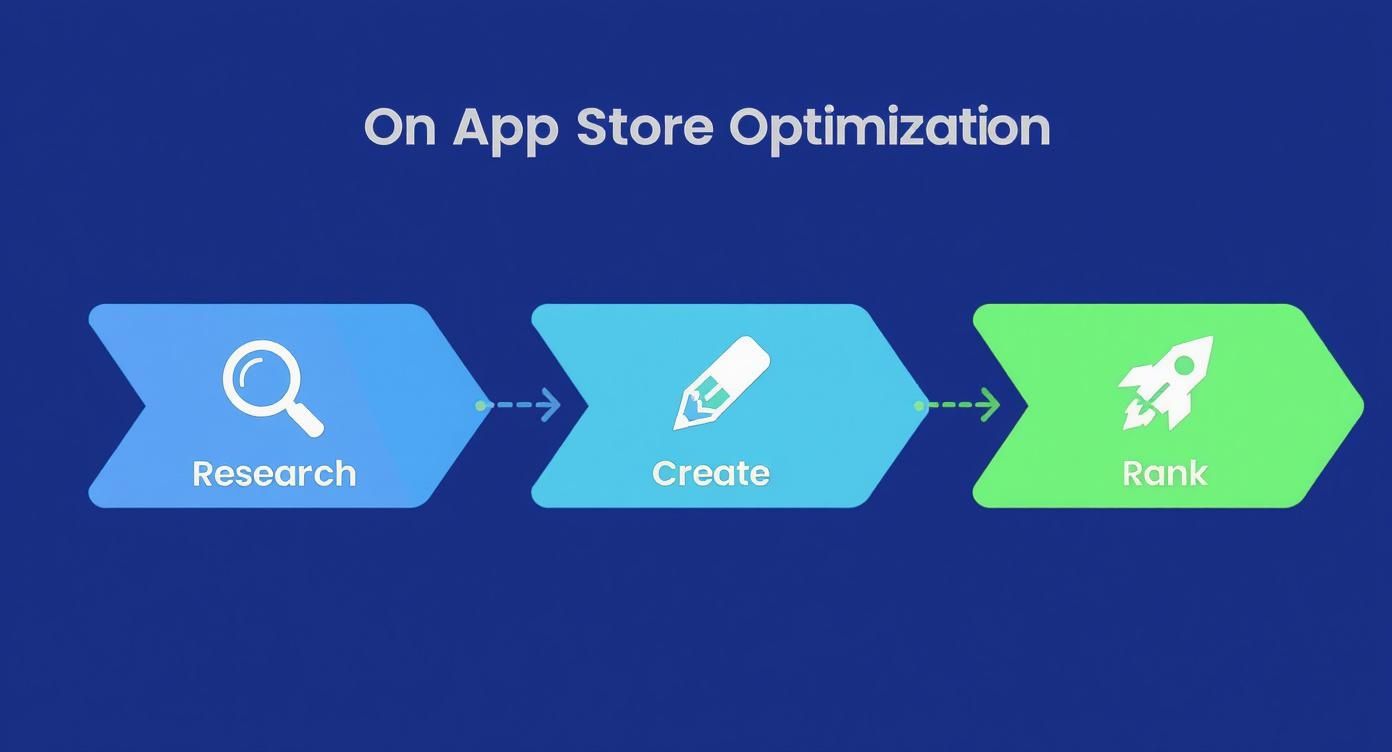
This simple flow—researching opportunities, creating and shipping changes, and then ranking and measuring the results—is the backbone of any data-driven growth strategy.
Accelerating Monetization with Modern Tooling
Historically, one of the biggest drags on the optimization cycle has been the app release process. Having to wait a week or more for App Store review just to test a small tweak on your paywall can kill all your momentum.
Thankfully, modern tools like AI paywall studios have completely changed the game. Platforms such as Nuxie let you design, target, and launch new paywall experiments in a matter of minutes, all without needing a new app release. You can test different prices, messages, layouts, and offers on the fly.
This ability turns your monetization strategy from a slow, frustrating process into a fast and agile one. Just imagine testing five different annual discount offers in a single week to pinpoint the one that maximizes subscription conversions. That kind of speed creates an incredibly powerful feedback loop, turning your user data into a direct and immediate driver of revenue growth.
Got Questions About Mobile App Optimization? We've Got Answers.
Jumping into mobile app optimization can feel like a lot. To help cut through the noise, I've rounded up some of the most common questions that developers and product managers ask when they're getting started.
How Often Should I Revisit My Optimization Strategy?
Think of optimization as a continuous loop, not a one-and-done project. Your market, your users, and your competitors are always on the move, so your strategy has to keep up. As a general rule, it's smart to take a hard look at your high-level strategy and goals at least once a quarter.
But different parts of the process have their own cadence:
- App Store Optimization (ASO): ASO is a fast-moving game. You should be checking your keyword rankings and what competitors are doing every week or two. Trends shift quickly, and you need to be ready to react.
- Performance Audits: The best times to run a full performance check are right after a major feature release, when a new OS drops (like a new iOS version), or any time you bolt on a significant third-party SDK.
- UX and Conversion Testing: Honestly, you should always have an A/B test running. This is where the real magic happens. Small, continuous experiments are the secret to those incremental gains that really add up over time.
What's the Real Difference Between ASO and SEO?
It’s easy to lump ASO (App Store Optimization) and SEO (Search Engine Optimization) together, but they play in completely different sandboxes with very different rules. Mixing them up is a surefire way to waste time and money.
ASO is all about winning inside the app stores—the Apple App Store and Google Play. The game here is getting your app to rank higher and look more appealing than the competition. Ranking factors are things like the keywords you use in your app's title, how many downloads you're getting, your user ratings, and whether your icon and screenshots grab attention.
SEO, on the other hand, is for ranking web pages on search engines like Google. It’s a much wider world, concerned with things like backlinks from other sites, the quality of your content, and the technical health of your website. The strategies couldn't be more different, though they can work together if you get into things like app indexing.
Here's the bottom line: ASO is about convincing a user on a product page to tap "install." SEO is about convincing a search engine your website has the best answer to a question. Same goal (visibility), totally different paths.
Which Metrics Actually Matter for Measuring Success?
The "best" metrics are the ones tied directly to your specific goal. Chasing vanity numbers like total downloads won't get you very far. You need to focus on the metrics that tell you the real story about your app's health.
Here’s how I break it down by area:
- Performance: Your north stars are Crash-Free User Rate (you should be aiming for 99.9% or higher) and App Load Time. These tell you if your app is stable and feels snappy.
- User Engagement: Keep a close eye on Daily Active Users (DAU), Session Duration, and especially your Retention Rate. It's not enough for people to download your app; you need to know if they're coming back.
- ASO: The numbers that count are App Store Impressions (how many eyeballs see your listing) and your Conversion Rate from view to install. This tells you if your page is actually persuasive.
- Monetization: For any app with subscriptions or in-app purchases, it all comes down to the big three: Average Revenue Per User (ARPU), Customer Lifetime Value (LTV), and Churn Rate. These are the metrics that will make or break your business.
Can I Really Optimize My Paywall Without Releasing a New App Version?
Yes, you absolutely can—and you absolutely should. Waiting on the app store release cycle to test your paywall is a huge bottleneck. It kills all your momentum. One poorly performing paywall can cost you weeks of revenue while you wait for Apple or Google to approve your fix.
This is where modern tools like AI paywall studios or remote configuration platforms come in. They let you change everything about your paywall—the design, the copy, the pricing, the offers—from a web dashboard, without shipping a single line of code.
This ability is a complete game-changer for monetization. You can run rapid-fire A/B tests to discover what actually works, then deploy the winning version to all your users in minutes. This isn't just a nice-to-have; it's a core part of how modern, effective mobile app optimization gets done.
Ready to accelerate your monetization experiments? Nuxie is an AI-powered paywall studio that lets you design, target, and launch high-converting paywalls in minutes without submitting a new app release. Find out more at nuxie.io.