
Monthly Recurring Revenue: Boost Growth Now
Discover monthly recurring revenue strategies to scale your mobile app. Learn key formulas, benchmarks, and actionable tips to grow steady.
Monthly Recurring Revenue (MRR) is the lifeblood of any subscription app. It’s the predictable, normalized income you can count on every single month from your paying subscribers. Think of it as the steady pulse of your business, giving you a real-time reading of its financial health and potential for growth.
Understanding Your App's Financial Pulse
Trying to grow a subscription app without tracking MRR is like flying a plane in the fog with no instruments. You might feel like you're moving forward, but you have no idea if you're gaining altitude or heading for a nosedive. MRR is your primary instrument—it’s the compass that tells you exactly where you are and helps you plot a course for where you want to go.
Simply put, MRR smooths out the peaks and valleys of your revenue. Instead of dealing with the unpredictable nature of one-time purchases, you get a clear, consistent figure. This predictability is what makes the subscription model so powerful. It lets you confidently plan your budget, ramp up your user acquisition spend, and make hiring decisions without just guessing.
Why Predictability Matters for Growth
Having a steady, predictable income stream isn't just about feeling secure; it's the engine for smart, sustainable growth. When you know roughly how much cash is coming in next month, you can make moves that would otherwise feel like a gamble.
- Smarter Financial Planning: MRR gives you a baseline for budgeting and forecasting. You can allocate funds for developing that new feature or launching a big marketing campaign with a much clearer picture of your resources.
- Building Investor Confidence: If you're looking for funding, a strong and growing MRR is one of the first things investors will look at. It's concrete proof that you have a viable business model and solid product-market fit, which almost always translates to a higher valuation.
- Confident Decision-Making: Knowing your MRR helps you answer critical questions. When is the right time to hire another engineer? Can we afford to invest in better server infrastructure? Should we double down on our paid ad channels?
This focus on predictable revenue is why the subscription model, particularly in SaaS, has taken off. The global SaaS market is on track to hit $390.5 billion in revenue by 2025, and that incredible growth is built on the foundation of recurring revenue. You can learn more about the explosive growth of the SaaS market and its reliance on this model.
At its core, monthly recurring revenue answers a simple but vital question: "How much money can we expect to bring in next month, assuming nothing changes?" This figure becomes the foundation upon which all other financial analysis is built.
To give you a clearer picture, here’s a quick breakdown of the core concepts we'll be diving into.
Key MRR Concepts At A Glance
| MRR Component | Description | Impact on Growth |
|---|---|---|
| New Business MRR | The monthly recurring revenue generated from brand new customers. | Directly increases total MRR and shows acquisition effectiveness. |
| Expansion MRR | Additional MRR from existing customers upgrading to a higher-tier plan. | A powerful growth lever; it's cheaper to upsell than acquire. |
| Reactivation MRR | MRR from previous customers who resubscribe after having canceled. | Indicates strong product value and effective win-back campaigns. |
| Contraction MRR | The reduction in MRR from customers downgrading to a lower-tier plan. | Decreases total MRR; often a signal of pricing or value issues. |
| Churn MRR | The total MRR lost from customers who cancel their subscriptions. | The primary force that works against growth; must be minimized. |
| Net New MRR | The sum of all positive MRR changes minus all negative changes. | The ultimate measure of your app's month-over-month growth. |
Each of these components tells a different part of your app's story. Throughout this guide, we’ll unpack how these pieces—new sign-ups, upgrades, downgrades, and cancellations—all fit together. Once you understand their interplay, you can stop just watching your MRR and start actively managing the levers that will drive your app's long-term success.
Getting to Grips with Your Core MRR Metrics
Knowing your top-line Monthly Recurring Revenue is a great start, but the real magic happens when you break it down. To truly understand what’s driving your app's growth (or causing it to stall), you need to look past that single number and get familiar with the different moving parts that make it tick.
Think of your total MRR like the water level in a bucket. It’s not just about how much is in there today; it's about seeing what's filling it up, what's leaking out, and what’s making the existing water level rise. Getting a handle on these individual flows is how you shift from just watching your revenue to actively steering it.
This diagram shows how a steady MRR becomes the engine for your entire business, fueling your ability to plan, invest, and create a cycle of sustainable growth.
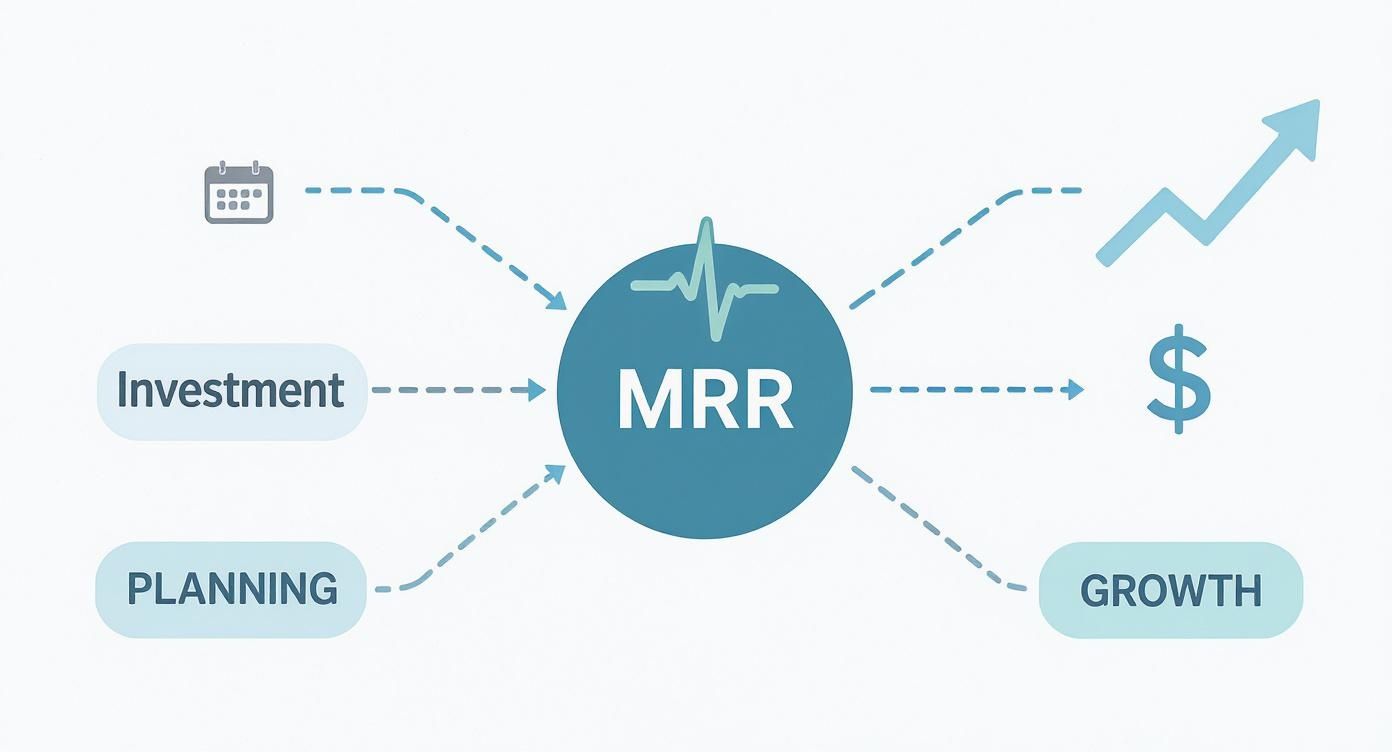
As you can see, a healthy MRR stream isn't just a number—it’s the foundation that gives you the confidence to make bigger bets and smarter plans for the future.
The Building Blocks of MRR Growth
First things first, let's isolate the different streams that feed into your total MRR. These are the absolute must-know metrics for any founder running a subscription app.
- New MRR: This one is simple. It’s the total recurring revenue you brought in from brand-new subscribers this month. It’s your clearest signal of how well your user acquisition is working.
- Expansion MRR: Sometimes called Upgrade MRR, this is all about getting more revenue from the customers you already have. It kicks in when a user upgrades from a basic to a premium tier or adds a new subscription feature.
- Churn MRR: This is the money you lose when existing subscribers cancel. It's the leak in your bucket, and keeping it as small as possible is crucial for long-term survival.
These three numbers are the DNA of your revenue growth. When you put them together, you get the clearest picture of your app's forward momentum. If you want to get deeper into the specific formulas, check out this guide to calculate monthly recurring revenue.
Calculating Your Net New MRR
The ultimate goal is to know if you're actually growing, and by how much. Net New MRR is the metric that tells you precisely that. It cuts through the noise and shows you the net change in your recurring revenue from one month to the next.
Net New MRR Formula: (New MRR + Expansion MRR) – Churn MRR = Net New MRR
Let's run through a quick example. Imagine your fitness app had the following activity in April:
- You signed up 100 new people to your $10/month premium plan. (New MRR = $1,000)
- 50 current users upgraded from a free tier to that same plan. (Expansion MRR = $500)
- 30 premium users canceled their subscriptions. (Churn MRR = $300)
Plugging those numbers into the formula, we get: ($1,000 + $500) – $300 = $1,200
That $1,200 in Net New MRR is a solid sign of healthy growth. On the flip side, a negative number is a serious red flag. It means you're losing more revenue from cancellations than you're gaining from new and upgrading customers—a trend you'd need to fix, fast.
Connecting MRR to Churn and Lifetime Value
Your monthly recurring revenue doesn't live on an island. It’s deeply tied to two other critical metrics that really tell the full story of your app's health: customer churn and lifetime value (LTV). Getting a handle on this relationship is the key to building a sustainable business, not just one that looks good for a single month.
Think of your MRR as a bucket you're trying to fill with water. New subscribers and upgrades are the faucets pouring water in. But churn? That's a hole in the bottom of the bucket. Even a small, slow drip can drain your bucket faster than you can fill it, making all your hard work to get new users feel like you're just treading water.
The Destructive Power of Churn on MRR
Churn is the silent killer of subscription apps. A 2% monthly churn rate might not sound like much, but it has a nasty compounding effect. That seemingly small number means you're losing nearly a quarter of your customer base—and their recurring revenue—every single year.
This puts you on a constant treadmill. You have to run faster and faster, signing up more new users each month just to replace the ones who left and keep your MRR flat. It’s an exhausting and expensive way to grow, and it completely undermines the stability that makes recurring revenue so attractive in the first place.
Churn acts as a constant downward pressure on your monthly recurring revenue. To achieve real growth, your New and Expansion MRR must not only replace what you lose to churn but significantly outpace it month after month.
Simply put, reducing churn is the most powerful lever you have to protect and grow your MRR. Plugging that leak means every new dollar you add actually contributes to growth instead of just backfilling a hole. This is why retention isn't just a "customer support" thing; it's a core revenue strategy.
How Retention Protects Your Revenue Engine
Customer retention is the bedrock of healthy MRR. After all, studies show that an average of 70% of subscription revenue comes from existing customers. The global subscription industry is projected to lose over $129 billion in 2025 due to churn, a huge chunk of which comes from easily preventable issues like failed payments. You can discover more insights about subscription economy trends at cashfree.com.
Minimizing churn has a direct, compounding effect on your bottom line. Here’s why it’s so crucial:
- It compounds growth: A retained customer keeps paying you every month, allowing your revenue base to build on itself without starting from scratch.
- It unlocks expansion: Happy, long-term customers are your best candidates for upgrades. They're the ones who will drive your Expansion MRR.
- It lowers acquisition costs: We've all heard it: it's far cheaper to keep a customer than to find a new one. Lower churn frees up cash to invest in your product instead of just pouring it into a leaky acquisition funnel.
Every single percentage point you can knock off your churn rate makes your entire growth engine more efficient and your MRR more resilient.
Linking MRR and Churn to Lifetime Value
This brings us to the ultimate report card for your business: Lifetime Value (LTV). LTV predicts the total revenue you can reasonably expect from a single customer throughout their entire time with you. It’s the final piece of the puzzle, connecting your monthly tactics to your long-term profitability.
It's pretty straightforward. A customer who pays you $10/month and cancels after three months has an LTV of $30. But another customer who pays that same $10/month and sticks around for three years? Their LTV is $360. While their monthly contribution to MRR was identical, their total worth to your business is worlds apart.
The formula for success is simple: high MRR per user + low churn = high LTV. That's the trifecta. A high LTV proves you aren't just acquiring random users; you're attracting and keeping the right users—the ones who find real, lasting value in your app and are happy to pay for it. To dig deeper into the numbers, explore our comprehensive guide on the customer lifetime value calculation formula.
Actionable Strategies to Grow Your App's MRR
Knowing your monthly recurring revenue is one thing. Actually growing it? That's a whole different ball game. It’s time to shift from being a passive observer of your metrics to an active driver of growth. This means making deliberate, data-backed changes that directly beef up your bottom line.
For app developers, this means looking beyond just shipping cool features and getting serious about the commercial side of your product. How you frame your value, price your plans, and walk users from a free trial to a paid subscription are all make-or-break moments that can either fuel or stall your MRR growth.
The great thing is, you don't need a massive overhaul. Small, consistent improvements in a few key areas can create massive, compounding wins over time. Let's dig into four proven strategies that top app developers swear by to build sustainable MRR.
Optimize Your Paywall with A/B Testing
Think of your paywall as the most valuable real estate in your entire app. It's the final handshake before a user decides if your app is worth their hard-earned money. Leaving its design and copy to a gut feeling is like leaving cash on the table.
A/B testing is your secret weapon here. It’s a simple concept: show different versions of your paywall to different groups of users and see which one converts better. By methodically testing things like pricing, plan features, or even the text on your call-to-action button, you can uncover what truly clicks with your audience.
A well-optimized paywall does more than just present prices; it communicates value. It should clearly answer the user's question, "What do I get, and why is it worth my money?"
To start running effective paywall tests, zero in on these variables:
- Price Points: Don't just set it and forget it. Try out different monthly and annual prices. You might be surprised to find that a slightly higher price can actually boost your average revenue per user without tanking your conversion rate.
- Tier Structure: Experiment with how you bundle features. Offering a "Pro" and "Premium" tier often works better than a single option because it caters to different user needs and budgets.
- Visual Design: Test everything from layouts and background images to the words you use to describe benefits. A cleaner look or more persuasive copy can make all the difference.
Finding that sweet spot is key. For a deeper dive into how to structure your tiers and pricing, check out these proven subscription pricing strategies used by other successful apps.
Boost Your Trial-to-Paid Conversions
Getting someone to start a free trial feels like a win, but it’s only half the battle. The real finish line is converting them into a paying subscriber when that trial ends. If your trial-to-paid conversion rate is low, it’s a flashing red light that users aren't seeing enough value to pull out their wallets.
The fix usually starts with a killer onboarding experience. Don't just dump new users into your app and hope they figure it out. You need to guide them straight to that "aha!" moment—the point where the core value of your app becomes crystal clear.
For a fitness app, that might mean helping a user create their very first workout plan. For a language app, it could be guiding them through their first fun, interactive lesson. This hands-on approach shows off your app’s magic much better than a generic tour of features.
Throughout the trial, use well-timed in-app messages or push notifications to highlight key features they might have missed. A gentle reminder of the value they'll lose if they don't subscribe can make the decision to upgrade feel like the most natural next step.
Implement Smart User Segmentation
Let's be real: not all your users are the same. A power user who opens your app every day is worlds apart from a casual user who logs in once a week. If you’re sending them both the same generic offer, you’re missing a huge opportunity to grow your MRR.
Smart user segmentation is all about grouping users based on their behavior, how engaged they are, or even their demographics. Once you have these groups, you can send highly targeted offers that feel personal and are way more likely to convert.
Here’s a quick playbook for segmenting your users to grow MRR:
- Find Your Biggest Fans: Identify users who are highly engaged but haven't subscribed yet. A targeted push notification with a "first-time subscriber" discount might be all they need to take the plunge.
- Target by Feature Use: If someone constantly uses a feature that has an even better version in your premium plan, hit them with an in-app message showcasing that specific upgrade. It’s relevant and timely.
- Launch Win-Back Campaigns: Create a segment of users whose trials just ended without a conversion. Wait a few days, then send them an email with a limited-time offer to come back and subscribe at a special price.
This kind of personalized marketing feels less like a sales pitch and more like a helpful suggestion, which dramatically boosts its effectiveness and directly feeds your Expansion MRR.
Before we dive into the final strategy, let's summarize these growth levers in a quick table.
MRR Growth Levers For Mobile Apps
| Strategy | Primary MRR Impact | Implementation Difficulty | Key Tactic |
|---|---|---|---|
| Paywall A/B Testing | New MRR & Expansion MRR | Medium | Test pricing, tiers, and copy to increase conversion rates. |
| Trial Conversion Optimization | New MRR | Medium to High | Improve onboarding to showcase value and use timely reminders. |
| Smart User Segmentation | Expansion MRR & New MRR | Medium | Group users by behavior to send targeted, relevant offers. |
| iOS SDK & Tooling | Churn MRR (Reduced) | Low to Medium | Use tools like RevenueCat to reduce bugs and dev overhead. |
As you can see, each strategy targets a different part of the MRR equation. A solid growth plan will eventually incorporate all of them, but starting with just one can make a significant impact.
Streamline Your iOS Implementation
For iOS developers, the technical side of subscriptions can be a real nightmare. Juggling StoreKit 2, validating receipts, and keeping track of subscription states across different devices can suck up engineering hours that you should be spending on your actual product.
This is where third-party tools are an absolute lifesaver. Platforms like RevenueCat offer a powerful backend that handles all the gnarly parts of in-app subscriptions, from processing payments to managing user access. Integrating a service like this can easily save your team hundreds of hours in development and ongoing maintenance.
Using a modern Swift SDK for either SwiftUI or UIKit is also a no-brainer. A type-safe, well-documented SDK makes the integration process smoother and cuts down on frustrating bugs. This frees up your team to focus on what matters most: the user experience. By focusing on designing the perfect paywall with tools like Nuxie, you can avoid getting bogged down in Apple’s complex subscription plumbing. A clean implementation always leads to a better user journey—and ultimately, higher conversions and a healthier MRR.
How MRR Shapes Your App's Valuation
When you step back from the day-to-day grind and look at your app's future, monthly recurring revenue stops being just another metric on a dashboard. It becomes the single most important driver of your company's total value. There's a reason investors, acquirers, and even bankers are obsessed with it: MRR signals predictability in a chaotic market.
Think about it this way. A business built on one-off sales is like a gig worker, always hunting for the next project. But a business with solid, growing MRR? That’s like someone with a stable, high-paying job. The second one is far less risky and, as a result, a whole lot more valuable. Predictable revenue is a massive de-risking factor for anyone looking to invest in or acquire your business.
Why Predictable Revenue is So Powerful
In the world of business valuation, predictability is king. A healthy MRR stream is the most compelling proof you can offer that your app has found its product-market fit. It shows you’ve built something so essential that people are happy to pay for it over and over again.
This consistency sends a few very powerful messages:
- You've built customer loyalty. Strong MRR paired with low churn proves your product is sticky—it’s become a part of your customers' lives.
- Your business model works. Recurring revenue gives you a stable financial base to reinvest in growth, whether that's hiring engineers or running marketing campaigns, all without the constant stress of chasing new leads.
- You're a safer bet. An acquirer sees they're buying a well-oiled machine that generates cash, not just a cool piece of code with unproven potential.
This kind of stability is so valuable that subscription-based companies often sell for 2-4 times more than similar businesses with transactional models. Buyers will happily pay a premium for the reliable cash flow that MRR guarantees, because it makes forecasting and planning for the future infinitely easier. For more detail on this, check out this great breakdown of how recurring revenue models impact business valuations.
To an investor, a dollar of recurring revenue is worth far more than a dollar from a one-time sale. It’s not just cash in hand; it's a promise of future cash, backed up by a track record of customer commitment.
From MRR to ARR Multiples
When the conversation turns to a funding round or an acquisition, you'll often hear the term Annual Recurring Revenue (ARR). Don't let it throw you off; it's just your MRR multiplied by 12. So, if your app is pulling in $50,000 in MRR, your ARR is $600,000. Simple.
Investors and buyers use ARR to put a price tag on your company, typically by applying a "multiple." For instance, a business with $600,000 in ARR might get valued at a 5x multiple, making the company worth $3 million.
But that multiple isn't set in stone. It can swing wildly based on the quality of your revenue. An app that's growing quickly with rock-bottom churn might command a 7x or 8x multiple. On the flip side, a stagnant business that's losing customers left and right might only get a 2x or 3x multiple.
This is where your daily work on optimizing MRR directly cashes out in the long run. Every point you reduce churn or add to your expansion MRR doesn't just look good on a monthly report—it can add millions to your company's final price tag.
Common MRR Mistakes and How to Avoid Them
Tracking your monthly recurring revenue gives you a vital sign for your app's financial health, but it's surprisingly easy to get the numbers wrong. Even small errors in your MRR calculation can lead to flawed strategic decisions, giving you a false sense of security or causing unnecessary panic. Think of it like a GPS that’s off by just one degree—at the start of your trip, it’s no big deal, but miles down the road, you’re completely off course.
To keep your reporting sharp, you need to be disciplined about what goes into your MRR formula. Most of the common blunders happen when you start including revenue that isn't truly "recurring." These missteps will inflate your numbers and hide real problems brewing under the surface.

Let's walk through the most frequent mistakes so you can make sure your metrics are clean, accurate, and genuinely useful for steering your app's growth.
Mixing Up Recurring and One-Time Revenue
This is, without a doubt, the number one mistake. The "R" in MRR is there for a reason—it stands for recurring. One-off payments have no business being in this calculation, as they create confusing and misleading spikes in your data.
- What to avoid: You just charged a customer a $500 setup fee or a $1,000 one-time consulting service. Don't add that to this month's MRR.
- What to do instead: Record those payments as separate, non-recurring revenue. Your MRR should only reflect the predictable income you can count on from subscriptions.
Mishandling Annual Contracts
It’s a fantastic feeling when a customer commits to a $1,200 annual plan. Your cash flow gets a healthy boost, but it's a huge mistake to book that entire $1,200 as MRR in the month they paid. Doing so completely warps your growth picture and makes month-over-month comparisons meaningless.
The right way to handle long-term contracts is to normalize them. You simply divide the total contract value by the number of months in the term to find its actual monthly contribution.
For that $1,200 annual subscription, you should recognize $100 in MRR each month for the next year. This approach smooths out your revenue and gives you a true picture of your committed income over time.
Ignoring Discounts and Fees
The sticker price isn't what lands in your bank account. If you forget to subtract things like promotional discounts or payment processing fees, you're looking at an inflated version of your financial performance.
- Discounts: A user signs up for a $20/month plan but uses a 25% off coupon. Their actual contribution to your MRR is $15, not the full $20. Always calculate MRR based on what the customer actually pays.
- Transaction Fees: While there's some debate, the cleanest approach is to calculate MRR after these deductions. This gives you a more realistic view of your net recurring revenue.
Steering clear of these common pitfalls will ensure your MRR figures are a reliable compass, accurately pointing to your app's real-world momentum.
Your MRR Questions Answered
Once you start digging into monthly recurring revenue, a few common questions always seem to pop up. Let's walk through them one by one to make sure you have a rock-solid understanding of the details. Getting these nuances right is key to talking about your app's financial health with total confidence.
What Is the Difference Between MRR and Total Revenue?
Think of your total revenue as the entire pie—every single dollar your business earned in a month. This includes one-time setup fees, professional services, or any other income that isn't from a subscription.
MRR, on the other hand, is just one very specific, very important slice of that pie. It focuses only on the predictable, recurring income from your active subscribers. By design, it filters out all the one-off payments to give you a clean look at the sustainable, ongoing pulse of your business. Keeping these two metrics separate is absolutely critical for accurate forecasting.
How Should I Account for Annual Contracts in MRR?
This is a big one. When a customer pays you $1,200 upfront for a yearly plan, it's tempting to log all that cash in one month. Don't do it. That approach creates a huge, misleading spike in your numbers and makes your growth look erratic and unpredictable.
The right way to handle this is to normalize the revenue. You simply divide the total contract value by the number of months in the term. For that $1,200 annual plan, you’d recognize exactly $100 in MRR for each of the next 12 months.
This smooths out your growth curve and gives you a true picture of your monthly momentum.
What Is a Good MRR Growth Rate?
There's no single magic number here, as it really depends on your app's stage. For a newer app just finding its footing, aiming for 10-20% month-over-month growth is a fantastic benchmark. Hitting that kind of number is a strong signal that you've found product-market fit and your acquisition channels are firing on all cylinders.
As you scale and your MRR base gets bigger, it naturally becomes much harder to maintain that explosive percentage growth. At that point, a healthy and sustainable rate might settle into the 5-10% range.
Ready to stop guessing and start growing your MRR? With Nuxie, you can design, A/B test, and ship high-converting paywalls in minutes without app updates. Learn how Nuxie can boost your subscription revenue.