
What Is Behavioral Segmentation for App Growth
Discover what is behavioral segmentation and how it drives app growth. Learn to leverage user actions for higher engagement, retention, and revenue.
Let's get straight to it: behavioral segmentation is all about grouping your users based on what they do in your app, not just who they are. It’s a shift in focus from static labels to dynamic actions—things like completing the tutorial, using a specific feature for the first time, or making an in-app purchase.
This approach lets you create experiences that feel incredibly relevant because they're based on a user's actual journey and intent. You're responding to their needs in real-time.
Why User Actions Matter More Than Identity

Think of it like this: imagine you run a coffee shop. Some people dash in for a quick espresso on their way to work. Others are regulars who grab the same pastry every morning. A third group settles in for hours, laptops out, nursing a single latte.
Traditional demographic segmentation might tell you their age or where they live, but that doesn't explain why they're in your shop or what they're likely to buy next. Are they there for a quick caffeine fix, a morning ritual, or a quiet place to work? Their actions tell the real story.
That’s exactly what behavioral segmentation does for your app—it gives you the context behind the user, letting you see the difference between someone just browsing and someone on the verge of becoming a power user, even if they look identical on paper.
Shifting from “Who” to “What”
This is where the magic happens. Instead of relying on static, often unchangeable attributes, you start focusing on the dynamic, ever-changing actions users take inside your app. For any mobile team, this is a game-changer because a user's behavior is the single best predictor of their future engagement and lifetime value.
To put it simply:
- Demographics: Cares about who the user is (e.g., age, gender, location).
- Behavioral: Cares about what the user does (e.g., completes onboarding, abandons a cart, uses a core feature).
This action-first approach is why the global behavior analytics market is exploding. It jumped from $1.10 billion and is on track to hit $10.80 billion by 2032. That kind of growth signals a massive industry-wide agreement: user actions are the most valuable currency for any app business. You can dive into the complete behavior analytics market forecast on Fortune Business Insights.
By observing user actions, you stop marketing to abstract profiles and start communicating with real people based on their demonstrated needs and intentions.
This mindset is the foundation for everything that matters: creating personalized campaigns, boosting user retention, and, ultimately, driving more revenue. It’s about meeting users where they are, based on what they actually do.
Why User Actions Predict More Than Demographics
In the world of mobile apps, what someone does tells you a whole lot more than who they are. Their actions inside your app are the clearest signal you have about what they'll do next. It’s the difference between a wild guess and an informed prediction.
Think about it this way. You could have two users who look identical on paper: both are 35-year-old women living in the same city. Demographically, they're twins. But one opens your fitness app every single morning, crushes a 30-minute workout, and tracks her meals religiously. The other opened it once three weeks ago, skipped the onboarding, and has been a ghost ever since.
Demographics tell you nothing useful here. Their behavior, however, tells you everything. One is a power user, practically begging for a premium subscription. The other is about to churn, and you'll need a smart re-engagement campaign to have any chance of getting her back. This is the whole point of behavioral segmentation—it gets to the intent behind the identity.
From Educated Guesses to Data-Driven Decisions
Sticking to demographics is like trying to find your way around a new city using a map from the 1980s. You might get in the right neighborhood, but you're going to miss all the one-way streets and new roundabouts. User behavior is your live GPS, guiding every move with precision.
When you focus on actions, you stop making broad, sweeping assumptions. Instead, you can have a real conversation with users based on what they've already shown you they need. This isn't just a "nice-to-have" strategy; it's a must for survival. Research consistently shows that when marketing is shaped by a user's behavior, purchases can jump by as much as 50% compared to a one-size-fits-all approach. You can dig deeper into the impact of psycho-behavioral segmentation to see just how effective it is.
Here's the simple truth: A user's past actions are the best indicator of their future intentions. Someone who just finished your onboarding is infinitely more likely to subscribe than someone who hasn't, no matter their age or location.
Real-World Scenarios Tell the Story
Let’s make this concrete. Imagine you're trying to promote a new premium feature. You could target two different groups:
- Segment A (Demographic): Users aged 25-34 in North America.
- Segment B (Behavioral): Users who have used the "Advanced Search" feature three times in the last week.
Now, which group do you think is more likely to pay for a feature that supercharges search? Segment A is a total crapshoot. Segment B is practically a sure thing. Their actions have already telegraphed a clear interest in the exact functionality you're about to improve.
This is where behavioral insights really shine. It helps you:
- Identify High-Value Users: Find the people who are genuinely hooked, not just those who fit a persona on a marketing slide.
- Predict Churn Risk: See the warning signs of declining engagement long before they hit the "uninstall" button.
- Personalize Offers: Send the right promotion to the right person at the right time, based on their actual journey in your app.
By shifting your focus from static profiles to dynamic actions, you stop marketing at people and start building relationships with them. And that’s how you build real, sustainable growth.
Key Types of Behavioral Segments for Mobile Apps
Knowing what behavioral segmentation is and knowing how to use it are two totally different things. The theory is great, but to make it work for your mobile app, you need to break it down into practical, actionable categories that connect directly to what people are actually doing. Think of these not just as labels, but as different lenses for understanding your user base.
This diagram helps visualize the split. User data has a few layers, but behavioral data is all about what a person does—the clicks, the taps, the actions—which is a world away from static information like their location.
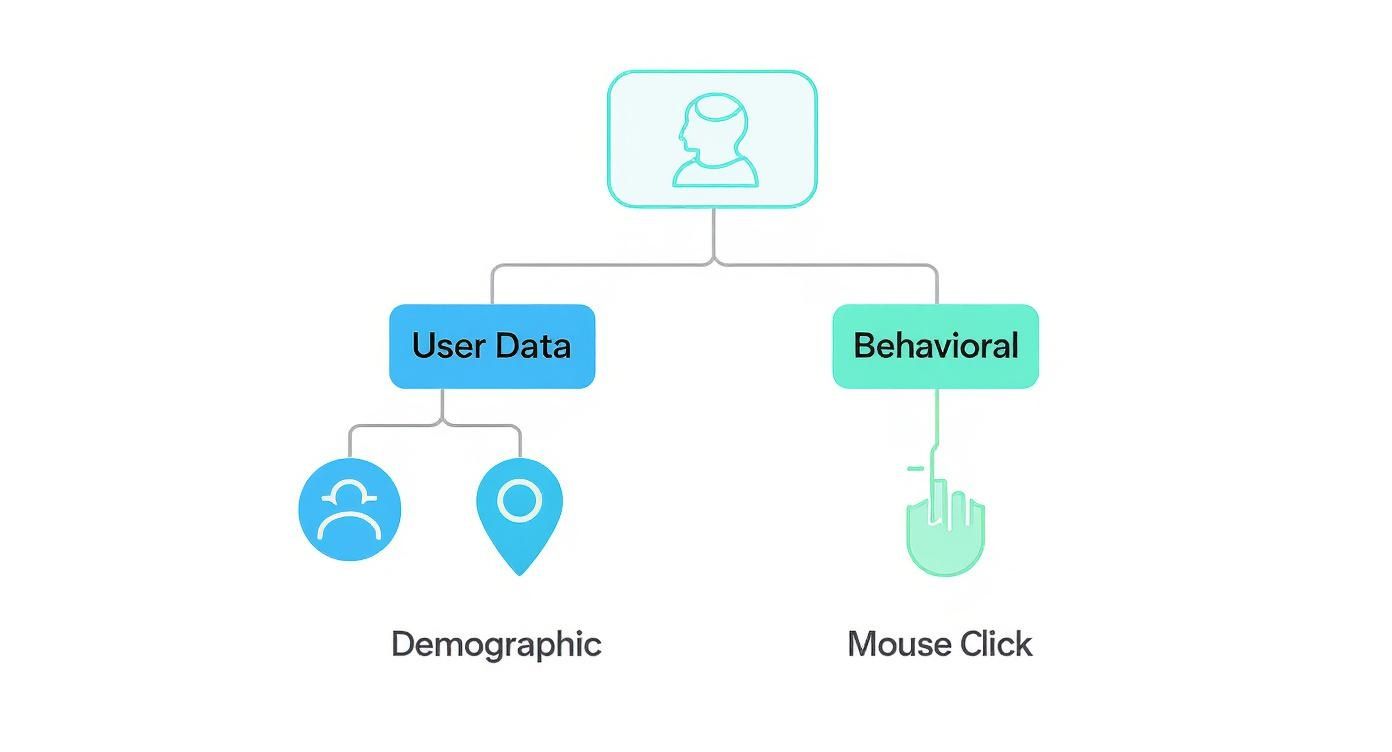
Here's the key takeaway: Demographics tell you who your users are, but their behaviors reveal their intent. It shows you what they actually want from your product. Let's dig into the core behavioral segments every mobile app team should be tracking.
Purchase and Spending Behavior
This is usually the best place to start because it's tied directly to revenue. When you segment users by how they spend money in your app, you can clearly see who your most valuable customers are and separate them from the casual, occasional buyer.
You can build some incredibly powerful segments by looking at:
- Transaction Frequency: How often do they buy? This simple question immediately splits your one-time buyers from your loyal, repeat customers.
- Average Order Value (AOV): Are they making small, frequent purchases or dropping a lot of money less often? This helps you spot your "whales" who drive a disproportionate amount of revenue.
- Product Category: What are they buying? Someone who buys a premium photo filter has a completely different motivation than someone who buys a pack of in-game currency.
- Promotion Sensitivity: Do they only buy when there's a sale? This identifies a "Bargain Hunter" segment that you can target with specific, discount-focused campaigns without cheapening the experience for everyone else.
Once you track these behaviors, you can get smart with your offers. Maybe you give your high-AOV segment early access to new features, while you send a 20% off coupon to your Bargain Hunters to nudge them into another purchase.
Feature Adoption and Product Usage
How people interact with your app’s features is a goldmine. It tells you exactly what they find valuable and, just as importantly, what they’re completely ignoring. This type of segmentation helps you guide users toward the features that will make them stick around longer.
Understanding feature adoption isn't just about crunching numbers for a product report. It's a roadmap for personalized communication. It tells you who needs a little help, who’s ready for the advanced stuff, and who is already getting a ton of value.
Some key segments here include:
- Power Users: These are the people who use your core features all the time and have probably discovered some of the more advanced tools. They're perfect candidates for beta testing or for asking for a glowing App Store review.
- Casual Users: They might only use one or two basic features and haven't explored much else. The goal here is feature discovery—using a subtle in-app message to point out another function they might love.
- Feature-Specific Adopters: These users live inside one specific feature but rarely touch anything else. This is a classic opportunity to introduce them to complementary tools that would make their experience even better.
- First-Time Feature Users: Someone just used a key feature for the very first time. A quick, well-timed message that says, "Nice! You just created your first project," can reinforce that positive action and encourage them to do it again.
Session Frequency and Engagement Level
This type of segmentation is all about the rhythm of a user's interaction. It answers the big question: "How often and for how long are people actually opening our app?" It’s a direct measure of how deeply your app is embedded in their daily or weekly life.
Common engagement segments are:
- Daily Active Users (DAUs): This is your most loyal crew. They show up every day, and your job is to keep the experience fresh and rewarding so they don't get bored.
- Weekly/Monthly Users: They see the value in your app, but it hasn't become a daily habit just yet. The goal here is to find ways to gently increase their visit frequency.
- Dormant or Lapsed Users: These are users who haven't opened the app in a while, maybe 30 days or more. They need a thoughtful win-back campaign to remind them why they downloaded it in the first place.
Putting Behavioral Segmentation Into Action
Knowing the "what" is one thing, but the real magic happens when you turn those insights into action. This is where the rubber meets the road—transforming raw user data into targeted campaigns that actually move the needle on your key metrics.
Let's shift from theory to strategy. Here are three powerful, real-world scenarios where behavioral segments can directly boost your app's bottom line.
Use Case 1: Converting Trial Users Into Subscribers
The free trial is arguably the most important stage of the user journey. It's your one shot to prove your app's value. A generic, one-size-fits-all approach just won't cut it. With behavioral segmentation, you can tailor your messaging based on how much a user is actually engaging with your app.
Here, the goal is to spot the users who are getting real value and give them a gentle nudge toward subscribing.
- Behavioral Segment: Users who finish onboarding and use a core premium feature at least twice in their first three days.
- Action: Send a targeted in-app message that connects their actions to the benefits of a paid plan.
- Example Message: "Wow, you've already created 3 projects! Ready to unlock unlimited projects and advanced exports? Upgrade today."
This message lands perfectly because it’s not a random sales pitch. It’s a relevant, timely prompt based on what the user has already done, making the upgrade feel like the natural next step.
Use Case 2: Boosting In-App Purchases With Personalization
Not everyone browsing your in-app store is ready to buy. Some are just window shopping, while others are on the fence. Behavioral segmentation lets you tell the difference and deliver the right offer at just the right moment.
By focusing on behavioral triggers, you can move from broadcasting generic discounts to orchestrating precise, personalized offers that feel less like an ad and more like a helpful suggestion.
Let’s say a user keeps looking at the same in-app purchase but never pulls the trigger. This is a classic signal of high interest mixed with a little hesitation.
- Behavioral Segment: A user views the same item three or more times in 24 hours without buying.
- Action: Send a modest, time-sensitive discount for that specific item. This creates a little urgency and helps overcome any price resistance.
- Example Message: "Still thinking about it? Get 15% off the 'Pro Filter Pack' for the next 3 hours only!"
This is so much smarter than a sitewide sale that devalues your offerings. It’s a surgical strike, targeting only users who are already close to converting. You can experiment with different offers and learn what works best by running experiments, a topic we cover in our guide to A/B testing for mobile apps.
Use Case 3: Winning Back Users at Risk of Churn
Identifying users who are slipping away before they're gone for good is the key to retention. A sudden dip in activity is a massive red flag. By creating a segment of these "at-risk" users, you can launch a proactive campaign to bring them back into the fold.
- Behavioral Segment: A user who was previously active daily hasn't opened the app in seven days.
- Action: Send a push notification that reminds them of the app's value. You could highlight a new feature, show a summary of their past activity, or offer a small incentive.
- Example Message: "We miss you! Check out the new 'Quick Edit' feature we just added to help you finish projects even faster."
This simple message shows you noticed they were gone and gives them a fresh, compelling reason to come back. It’s a targeted intervention that can stop a user from becoming just another churn statistic.
Behavioral Triggers and Corresponding App Marketing Actions
To make this even more concrete, here’s a table that connects common user behaviors with specific, actionable marketing responses. Think of it as a playbook for turning user actions into growth opportunities.
| Goal | Behavioral Segment (Trigger) | Recommended Action (e.g., Push/In-App Message) | Example Message |
|---|---|---|---|
| Increase Engagement | User has not used a key feature yet. | In-app message showcasing the feature's benefit. | "Did you know you can create custom templates? Tap here to save your first one!" |
| Drive Social Sharing | User completes a major milestone (e.g., level 10). | Prompt to share their achievement on social media. | "You just reached Level 10! Share your new badge with your friends." |
| Upsell to a Higher Tier | Power user hits a limit on their current plan. | In-app alert explaining the benefit of the next tier up. | "You've reached your 10-project limit. Upgrade to Pro for unlimited projects." |
| Gather Feedback | User has had 10+ sessions but hasn't left a review. | A friendly in-app prompt asking for an App Store rating. | "Enjoying the app? A quick rating would mean the world to us!" |
This table illustrates just a few possibilities. The key is to always think about the user’s context and what message would be most helpful or motivating at that specific moment.
How to Implement Your First Segmentation Strategy
Getting started with behavioral segmentation isn’t some massive, all-or-nothing project. The trick is to start small. Nail one specific goal, prove the value with a clear win, and then expand from there. Think of it as a focused experiment, not trying to boil the ocean.
This simple roadmap will walk you through turning a business goal into a live, targeted campaign.
Define Your Goal and Key User Actions
First things first: forget about the data for a second. The whole process starts with a simple question: What business outcome are we actually trying to achieve?
Maybe you need to boost trial-to-paid conversions. Or perhaps your focus is on reducing churn or driving more in-app purchases. Your goal dictates everything that follows because it tells you which user actions matter most.
Let's pick one high-impact goal to start. Imagine your top priority is getting more free trial users to pull out their credit cards and subscribe.
With that goal locked in, you need to identify the "aha moment"—that series of actions a user takes that tells you they're getting real value and are on the verge of converting. For a fitness app, that moment might be after they complete their third workout. For a project management tool, it could be when they invite their first teammate.
Once you have your goal and those key actions, you can build your first simple segment:
- Goal: Increase trial-to-paid conversion rate.
- Key Action: User completes onboarding AND uses a core premium feature twice.
- Segment Name: "Highly Engaged Trial Users"
Just like that, you’ve created a powerful group to talk to. You’re no longer shouting at all trial users with the same generic message. Instead, you're focusing on the ones who have basically raised their hands to show they're interested.
Choose Your Tools and Launch a Campaign
With your segment clearly defined, it’s time to act on it. You’ll need the right tools to track these behaviors and then trigger campaigns automatically. Thankfully, modern platforms make this incredibly easy, letting you define segments and events with just a few clicks.
If you want to see how the building blocks fit together, you can learn more about setting up segments and events in your marketing tools.
For our "Highly Engaged Trial Users" segment, a perfect campaign would be a targeted in-app message. It shows up at just the right time, acknowledges their progress, and frames the upgrade as the natural next step in their journey.
Example Campaign: Trigger: User enters the "Highly Engaged Trial Users" segment. Action: Display an in-app message. Message: "You've already created 3 projects! Ready to unlock unlimited projects? Upgrade now."
This kind of message just works. It’s timely, it's relevant, and it’s directly connected to what the user has already done in your app. It’s a completely different universe from a bland, one-size-fits-all "Your trial is ending soon" notification.
Big players like Amazon built their empires on this principle. Their famous recommendation engines are powered entirely by behavioral data, proving that watching what users do is the key to driving massive growth. By starting with one focused campaign, you can measure the impact, learn what resonates, and build momentum for an even smarter segmentation strategy down the road.
Your Path to Smarter App Marketing
Behavioral segmentation isn't just another marketing fad. It's a fundamental change in how the most successful apps actually understand and grow their audience. When you shift your focus from simple demographics to what users do inside your app, you open up a whole new world of possibilities for driving engagement, boosting conversions, and seriously improving retention.
The whole journey starts with one, single step.
Your first move is to pinpoint one key action that tells you something important about a user's intent or value. Maybe it's completing the onboarding flow, trying a premium feature for the first time, or even just showing signs they're about to drift away. Focus on tracking that one behavior, learning the patterns behind it, and then acting on what you find. This is how you start building a smarter, more effective marketing engine.
The most powerful insights don't come from knowing who your users are, but from understanding what they need. Behavior is the language they use to tell you.
For example, simply identifying users who haven't opened your app in seven days gives you a perfect audience for highly effective win-back campaigns. A targeted message to that specific group will almost always outperform a generic marketing blast sent to everyone, delivering real results and building the momentum you need to tackle your next big goal.
Frequently Asked Questions
Even when you've got a solid grasp of the strategy, some practical questions always pop up when it's time to roll up your sleeves and get to work. Let's tackle some of the most common ones that mobile teams ask.
What’s the Main Difference Between Behavioral and Demographic Segmentation?
The simplest way to think about it is actions versus attributes.
Demographic segmentation puts people in boxes based on who they are—things like their age, gender, or where they live. These are static traits. Behavioral segmentation, on the other hand, groups them based on what they do inside your app.
It's all about their actions: what features they use, how often they log in, or what they've bought in the past. Honestly, what someone does is a much better clue about what they'll do next than their demographic profile.
How Much Data Do I Need to Start?
You probably need less than you think. You don't have to boil the ocean or have a massive, complex dataset to get your first win.
The trick is to start small and focus. Pick just one or two critical user actions that are directly tied to a business goal. This could be something as simple as finishing the onboarding tutorial, trying a core feature, or making that first purchase.
Once you get that running, you can gradually build out more sophisticated segments as you collect more data and get a better feel for how people use your app. It’s all about starting small and iterating.
What Are the Biggest Challenges of Implementation?
Getting behavioral segmentation off the ground usually involves a few common hurdles, but none of them are deal-breakers if you plan ahead.
Here's what teams run into most often:
- Data Hygiene: The old "garbage in, garbage out" rule applies here. Your data has to be clean, accurate, and consistent. If it’s not, your segments will be flawed, and your campaigns will miss the mark.
- The Right Tools: You need a platform that can do two things well: analyze the user behavior and then let you act on those insights with targeted campaigns. One without the other is just a missed opportunity.
- Shifting the Mindset: Sometimes the biggest challenge is internal. Moving a team away from a "one-size-fits-all" mentality toward a more personalized, segment-driven approach requires a bit of a cultural shift.
Ready to turn those behavioral insights into real revenue? With a tool like Nuxie, you can design, target, and launch high-converting paywalls and in-app campaigns based on what your users actually do. You can get started in minutes.